

What Nobody Tells You About Substack Income When You're Over 50
The truth about paid subscriptions and better ways of monetizing Substack.

Hey, wise adventurer,
If you’re thinking about monetizing Substack through paid subscriptions alone, that single decision might be the one that makes you quit.
Most people over 50 assume the path to Substack income is simple: write good content, put it behind a paywall, and wait for subscribers to pay.
But here’s what nobody tells you.
If you’ve never run a business — especially a publishing business — or don’t have a background in marketing and sales, paid subscriptions are likely the slowest and hardest monetization path you could choose.
I know this because I’ve spent 22 months on Substack. I grew to 5,000 subscribers in my first ten months. Then my growth stalled. I’m currently at around 4,600+ free subscribers — and I’ve built 6 different income streams along the way.
That experience taught me something most successful creators won’t admit publicly: the people with the strongest paid conversion rates almost always had a business or marketing background before they ever wrote a word on Substack.
If that’s not you — and for most people over 50, starting from scratch, it isn’t — there are faster, more honest paths to your first real income.
I’m not against paid subscriptions. I have them. I’m grateful for every single one. But treating paid subscriptions as your only monetization strategy — especially when you’re just starting out — is where most people over 50 get stuck, burn out, and eventually quit.
Think of paid subscriptions as one component of a diversified income strategy — not the foundation you build everything else on. At least not yet.
In this newsletter, I’m going to show you what actually works — based on 22 months of real experience, real numbers, and some lessons I learned the expensive way.
Let’s start with the truth nobody wants to say out loud.
The math nobody shows you
Substack officially claims a 5%-10 % free-to-paid conversion rate.
The reality? Based on my own experience and honest conversations with some of the most successful newsletter owners on this platform, the real number is closer to 1-3%.
Here’s what that actually means in practice:
At 2% conversion rate, you need 5,000 free subscribers to get 100 paid ones
At $10 a month, that’s $1,000 — before Substack’s 10% cut and Stripe fees
Most people take 12-24 months to reach 5,000 subscribers. Often longer.
The creators with the highest conversion rates almost universally have a business or marketing background
Substack is a community hub that feeds into everything else.
It is not a standalone revenue machine — especially not in the beginning.
I’m not telling you this to discourage you. I’m telling you this so you don’t spend a year doing the wrong thing first and quit before you ever see what’s actually possible.
Most people will never buy from you — and that’s completely fine
Here’s the uncomfortable truth about any online audience:
About 1-2% will ever become paying clients, whatever you sell
That means roughly 98% of your audience will never buy anything from you
The best conversion rates belong to creators with sales and marketing experience
If selling makes you uncomfortable, conversion will be even lower
But that doesn’t mean the other 98% are worthless to your business. Far from it.
Some of your most valuable readers will never pay you directly. They will:
Restack your content and put you in front of hundreds of new readers
Recommend your newsletter to their own audiences
Collaborate with you and open doors you didn’t expect
Refer paying clients your way without you ever asking
Focus on the people who show up consistently. Serve them well. The paying clients will emerge from within that group — but so will opportunities you never anticipated.
Paid subscriptions don’t work just because you put up a paywall
I have 62 paid subscribers and just over $4,000 in paid subscription revenue.
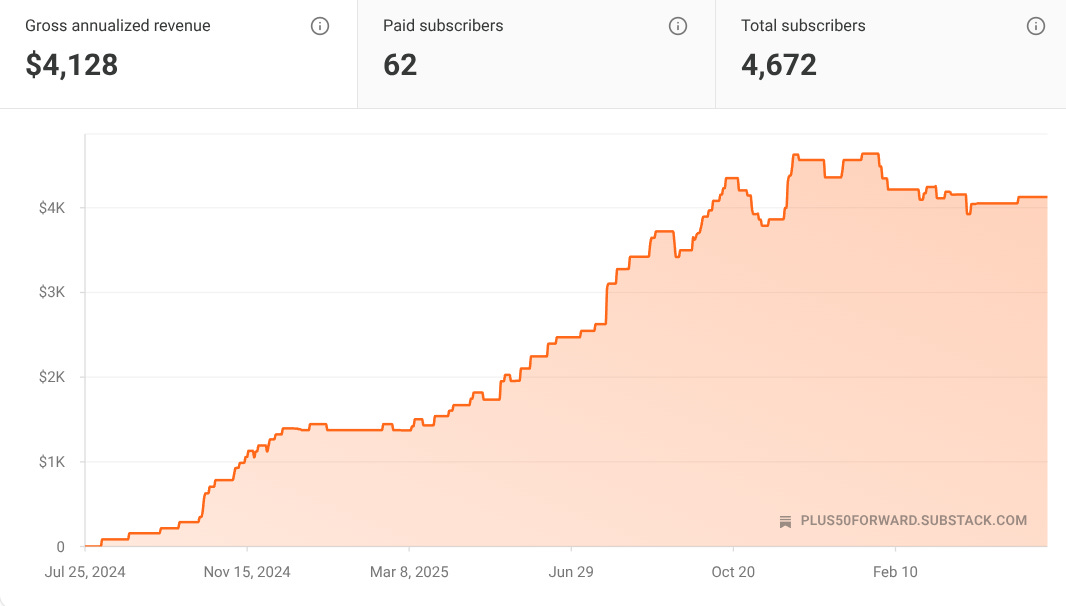
I’m sharing this because you deserve the real number, not a polished version.
Here’s what those 62 people taught me:
They didn’t subscribe because I put up a paywall
They subscribed because something tangible and useful was on the other side of it
Templates, frameworks, real numbers, and direct access to me — that’s what converted them
People pay when what’s behind the lock is clearly worth more than the key costs
What actually works behind a paywall:
Step-by-step frameworks they can use immediately
Fill-in-the-blank templates that save them hours
A private community or monthly Q&A with direct access to you
Real examples with real numbers — not theory
What doesn’t work:
More of the same content you already give away for free
Generic advice they can find anywhere
A paywall with no clear promise of what’s on the other side
I used to run a monthly workshop for paid subscribers. In theory, it sounds great. In practice, the preparation time wasn’t worth what I was earning from it. I was spending hours every month creating something that wasn’t moving the needle.
The honest question before building any paid offer: how much time do I actually have — and is this the best use of it?
The fastest real path — coaching and consulting
I started with free calls.
Not because someone told me to — but because I needed to build confidence and understand what people actually needed. I even bought a course from a trusted creator on how to conduct paid calls properly. One of the best investments I made early on.
After a handful of free calls and a few testimonials, I started charging. And that’s when something shifted — not just in my income, but in my entire understanding of what my audience actually needed.
Here’s the progression nobody talks about openly:
Free calls build confidence and remove the fear of selling
Paid calls generate your first real income and collect testimonials
Patterns from those conversations reveal exactly what people struggle with most
Those patterns shape a high-ticket coaching offer that solves the real problem
The high-ticket offer is what eventually solves the income problem that calls alone never could
This matters because coaching and consulting on their own won’t replace a salary overnight. But they fund the journey while you build something bigger — and they give you something no amount of third-party research ever could.
The most valuable business intelligence I have didn’t come from Reddit threads, Facebook groups, AI tools, or Google trends. It came from direct conversations with real clients.
People tell you publicly what they think they need. They tell you privately what they actually struggle with. Those are two completely different things — and the gap between them is where most online businesses quietly fail.
Then something unexpected happened.
One of my regular clients is a 7-figure earner. You might wonder why someone at that level would pay for coaching. She answered that herself on our very first call:
“I already learned more in the first 20 minutes than I expected.”
People become successful because they understand better than anyone that time is the one resource you can never recover. You can always make more money. You cannot make more time.
People who fail see paying someone to get the results they want as an expense. Successful people see it as an investment.
You don’t need to know everything — and you never will. Neither will I. But paying the right person to fill that gap gets you results faster than any course, any book, or any amount of solo figuring-it-out ever could.
That’s what coaching and consulting actually sell:
Certainty in moments of confusion
Time saved on expensive mistakes
Focused attention on their specific situation
A faster path to results they could eventually reach alone — but not as quickly
The simple math of getting started:
10 sessions × $100 = $1,000
5 sessions × $200 = $1,000
3 packages × $350 = $1,050
It’s the least scalable income stream. But it’s the fastest path to real money, real results for your clients, and real insight into what your high-ticket offer should eventually look like.
No course to build. No funnel to set up. No audience of thousands required.
You can start today.
Your existing network, your current subscribers, and decades of hard-won experience are all you need to begin.
Maybe you’ve been following the wrong advice
Here’s a story I don’t tell often.
I spent weeks building my first online course — about making money on Medium, the platform where I’d had my first real online success. I worked hard on it. I was proud of it.
I never launched it.
By the time I finished, Medium had completely changed its algorithm. The course was no longer relevant. All that work, all that time — gone.
The lesson that changed everything for me:
Never build something entirely dependent on a platform you don’t control
Your email list is the only audience you truly own
Followers on any platform can disappear overnight — email subscribers cannot be taken from you
Platform rules change. Your email list doesn’t.
Most influencers and large accounts will tell you to create a digital course. And eventually — yes. But if you’re just starting out without an engaged audience, who exactly is going to buy it?
The easier path to a digital product:
Take your most popular existing content
Go deeper on the topic
Add templates, frameworks, and shortcuts
Turn it into something people can implement immediately
That’s exactly how I created my eBook — directly from one of my most engaged newsletters.
For a couple of months, I consistently made $200- $600 from selling an ebook and a mini-course.
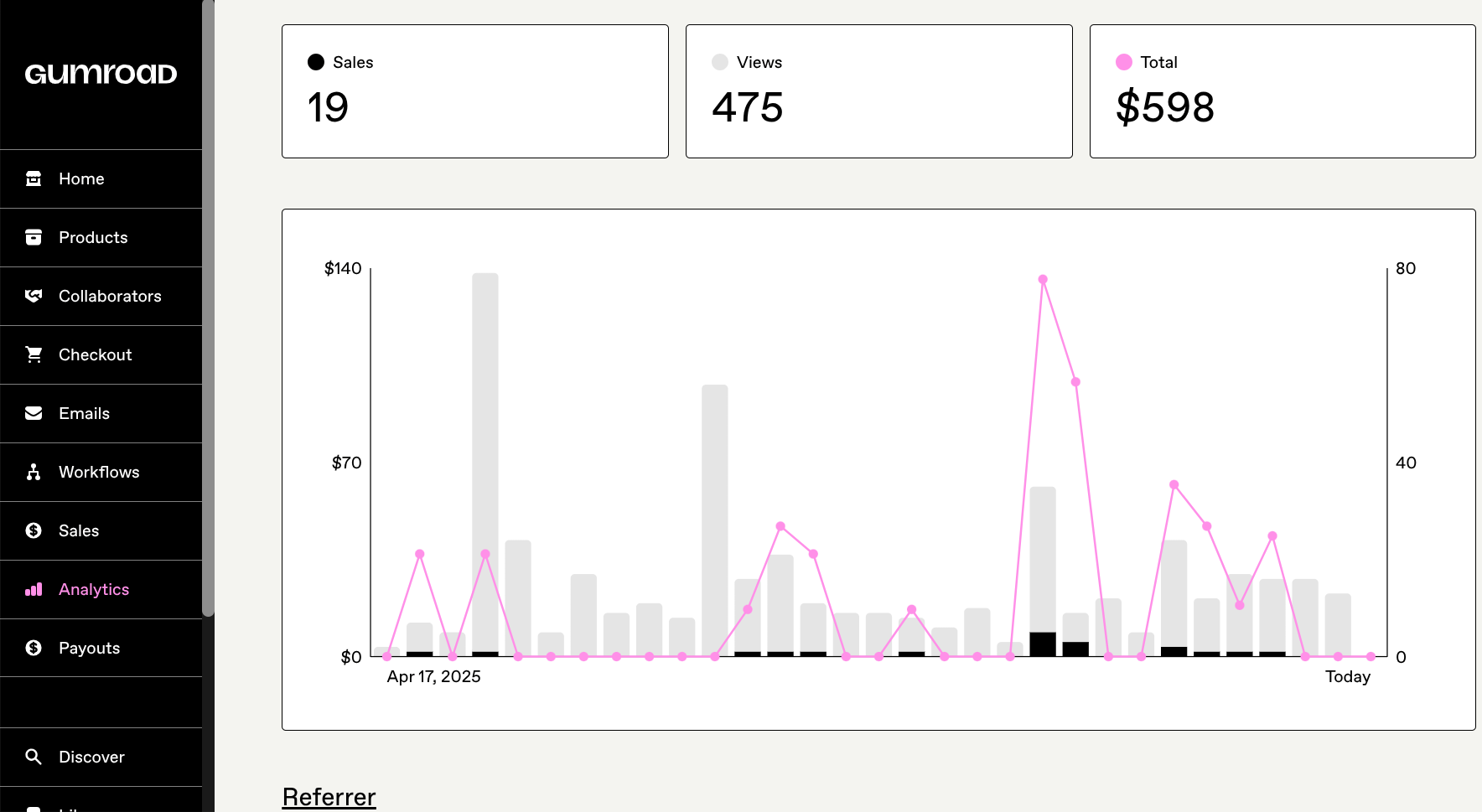
Then it dropped off. Because I stopped promoting it.
There is no such thing as fully passive income. Every income stream requires ongoing attention to keep working. The sooner you accept that, the more intentional you’ll become about where you put your energy.
The real takeaway
Substack is a community hub — not a standalone revenue machine.
Even publishers making multiple six figures aren’t making that money from paid subscriptions alone. They’re using Substack to build trust and funnel readers toward high-ticket offers — coaching, consulting, cohorts, and communities. The subscription is the door. What’s behind it is the real business.
That’s the reframe that changes everything.
Stop asking: “How do I get more paid subscribers?”
Start asking: “What am I building that paid subscribers can be part of?”
You are not competing with 25-year-old influencers who post twelve times a day. You are someone with decades of lived experience that people will genuinely pay for — because it saves them time, spares them mistakes, and gives them certainty when they need it most.
That’s rare. That’s valuable. And it doesn’t require 10,000 subscribers to monetize.
Start with what you already have:
One clear offer
One specific problem you solve
One type of person who has that problem
Build trust first. Let the coaching and consulting fund the journey. And let paid subscriptions grow naturally as one part of something much bigger.
P.S.
You asked for a step-by-step way to start earning online — so I built it.
Next week, paid subscribers get a 7-day challenge: 7 Days to Your First $500
One email a day. Step-by-step instructions. Templates. Prompts.
Everything you need to turn decades of experience into your first paying client.
Let's get you paid.
Rock the world, not the chair.
Found this useful? ♻️ SHARE ♻️ it with friends, colleagues, or anyone ready to turn their expertise into income and build freedom on their own terms.

Jerry, I appreciated your honest share about your numbers and experience with paid subs. I recently had an exchange with another Substack publisher and they too fell in the 1-3% range. I've experienced the same.
I have found the same benefits you mentioned about the 98% and they mean the world to me.
As I've mentioned, I already have a small coaching practice and am writing another book so to me Substack paid subs are the gravy, not the focus as you always emphasize.
I also get a lot of other benefits in the form of an opportunity to be creative to balance out my day job and experiment with various topics.