

Don’t Get Hooked: Scams I’ve Seen Up Close (and How to Avoid Them)

This is a guest post by the Cyber Safety Watchdog.
One of the things I’ve learned in my work teaching people about scams is that none of us is immune, not even those of us who study this every day.
I’ve run into several scams myself, and I am sharing them here because they illustrate just how easy it is to get pulled in.
The more you know what these scams look like, the easier it is to protect yourself.
🚨 Scam Spotlight 1: The Fake “Account Violation” Message
Just this week, I received 7 of these messages over a 2-day span!
Here is one of them:
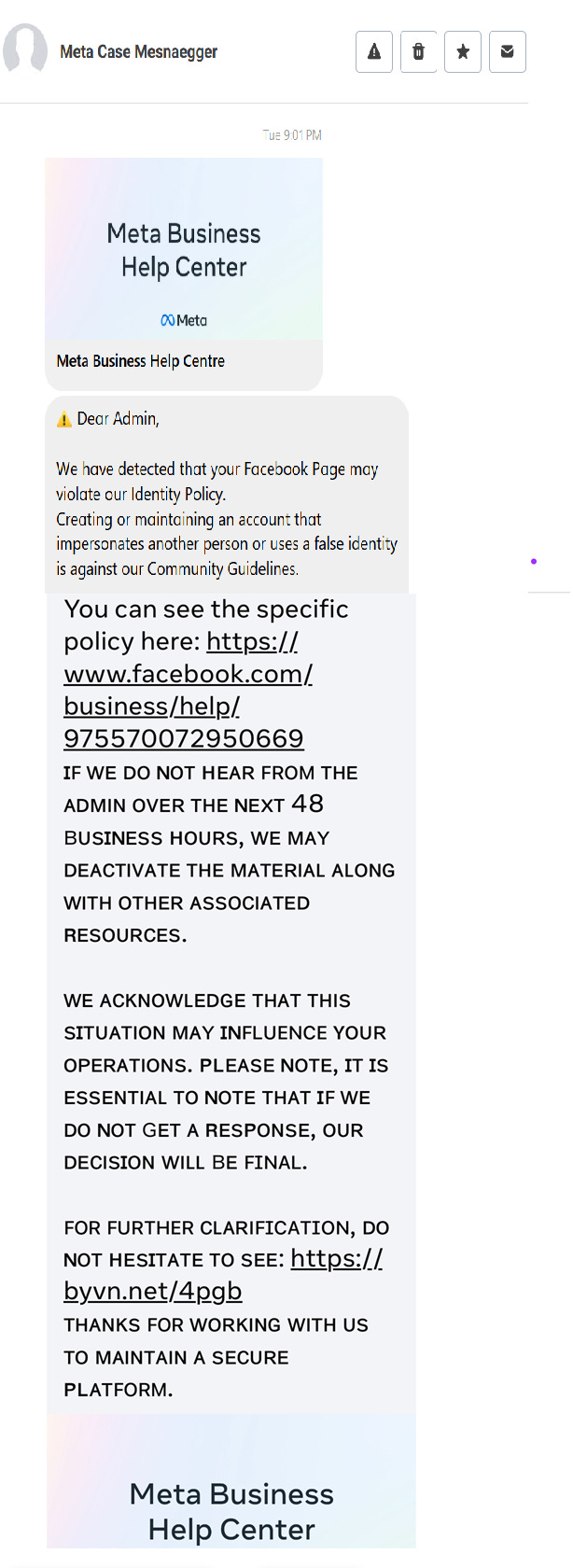
Most of these types of messages use the same methods of fear, threats, and urgency. They are saying I violated one of their policies and that if I do not respond within 48 hours, my page will be deleted with no chance to reactivate it.
That’s a scary thought! When I received my first one of these last year, I will admit I freaked out. Luckily, I took a step back to look at it more closely.
At first glance, the actual message looks legitimate with Meta images and logos. Some even contain a blue check mark, which is supposed to indicate that it has been “verified.” When you take a closer look, you start to see what you might have missed while in panic mode.
I actually could not believe I didn’t notice Messenger’ was spelled wrong at first! The greeting “Dear Admin” is another red flag. The wording of the message is also rather odd. This particular message is interesting because the link to the Facebook policy appears legitimate and likely is; however, the second link raises another red flag.
Clicking the link would have likely led to a “Facebook login” page. When someone enters information into a fraudulent page, their keystrokes are recorded, which means the scammer would now have my actual username and password had I done that.
With that information, they would likely have reset the password on the account and taken control of it. I would have had little to no recourse at that point. Sadly, Meta support is notoriously weak, useless, and unwilling to help legitimate users regain control over their accounts.
Red flags to remember:
Social media companies don’t send threats by private message.
Urgent language (“act now,” “final warning”) is meant to scare you.
Always check the actual sender and web address, and never click links in messages, even if they look official.
If you are looking to start a side career and create a social media component for your business, be very careful if you receive a message like that one on any platform.
🚨 Scam Spotlight 2: Too-Good-to-Be-True Collaborations
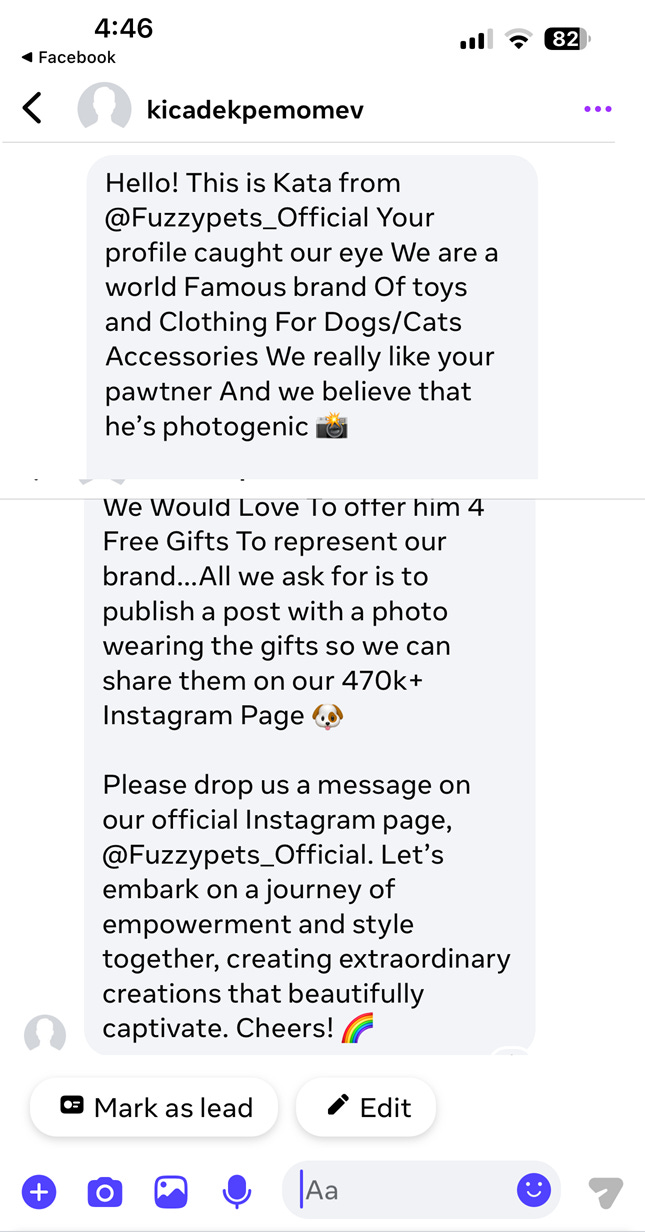
Another time, earlier in my journey, I was offered a “partnership” with a pet-product company because I had a pug as my account mascot.
They said they’d send me free products if I just covered the shipping fee. I reluctantly did it (ignoring my gut), justifying more exposure in exchange for the expense. I actually did receive the items. I photographed my dog with the item and tagged and posted them as instructed. It went nowhere.
They were doing the same thing to tons of other people and accounts. This was all they did, it seems. That was their scam: make money on inflated shipping fees while gaining exposure from unsuspecting accounts. The account is no longer valid. This was the initial contact:
Red flags to watch for:
Offers that don’t fit your content or audience.
Generic, copy-and-paste messages with no personal touch.
High shipping or “processing” fees for supposedly free items.
New accounts with lots of followers
The entire account is made of “tagged” photos and videos
A quick tip: use reverse image search on suspicious accounts.
You’ll often find many of their photos come straight from stock libraries.
🚨 Scam Spotlight 3: The Get-Rich-Quick Scheme Trap
This one I’ve observed more than I have experienced directly.
You’ve probably seen the ads: “Earn six figures working 30 minutes from home,” “Quit your job in 30 days,” or “Turn one workshop into passive income. I earn $10K/month”!
While many business coaches are certainly legitimate, some may lure you in with free workshops only to push more expensive programs. Often, your success depends less on building a business and more on upselling and recruiting new members, which slides dangerously into pyramid scheme territory.
Red flags to watch for:
High-pressure sales tactics.
Vague promises about success, without concrete steps.
Quick upsells to “better courses”
Heavy focus on recruiting others rather than building your own business.
The Big Picture
What ties all these scams together is urgency and pressure, as well as preying on something you lack.
You may desperately want to leave your 9-5, and you might find yourself down the “overnight success, six-figure work 3 hours a day” rabbit hole. Scammers or just plain greedy people want you to react before you have time to think. Slowing down, double-checking, and asking, “Does this make sense for me?” are simple but powerful defenses.
If this resonates with you, know that you’re not alone. I write a weekly newsletter, Cyber Safety Watchdog Weekly, where I share the latest scam alerts, red flags, and practical tips, particularly for those navigating new online opportunities.
Please consider subscribing and maybe even forwarding it to a friend or older relative who could use the extra protection. The 50+ demographic is one of the most vulnerable to scams! Education and awareness are your best weapons.
I’d like to thank Jerry Keszka for sharing this space and allowing me to connect with his audience!
I hope to see some of you over at Cyber Safety Watchdog Weekly!
 | A guest post by
|
Thank you, Cyber Safety Watchdog, for sharing information about common online scams and their warning signs. They become increasingly common and sophisticated. Good reminder on online safety.